Archive for May, 2010

Beginner’s Guide to Hiking Oahu

Above
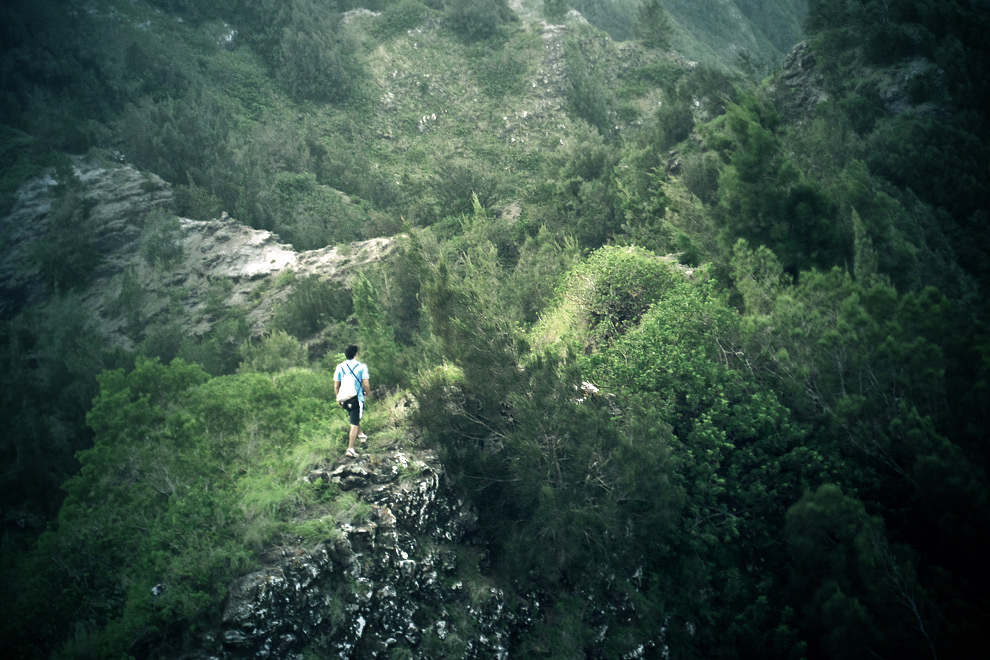
Connecting Mariner’s Ridge to Kuliouou.

I’ve been hiking in Hawaii since early 2009. In the winter months when surf in the South Shore is flat and surf in the North Shore is monsterous, I needed something to do to stay active. Hiking fit the bill and once I got into it, I found out there are more hikes on Oahu than I could have ever imagined. When you’re a transplant to Hawaii like me, there are a few bits of info that’ll help you figure out how the hiking trails work.

The Koolau and Waianae Mountain Ranges

When you read about hiking on Oahu you’ll hear these names a lot. Most of the hikes are on one of the two mountain ranges. See, the island of Oahu was formed by two volcanos, the Koolau Volcano in the east and the Waianae Volcano in the west. As they erupted over time, they rose out of the ocean creating two mountain ranges. The volcanoes eventually filled in the space between them to form the island of Oahu.

The Koolau and Waianae Ranges run almost parallel to each other from the south to north shore. On the top of each range is a ridge trail. And there are hundreds of ridges that stem off perpendicular to the main ridge. Many of these off-shoot ridges are also hikeable and have off-shoot ridges of there own. Once you start exploring new trails and connecting ridges you’ll find that even though Oahu is small, there’s plenty of hiking terrain. And I haven’t even mentioned the valley trails between each ridge. (I tend to stay on the ridges. Less chance of running into wild boars.)

A note on trail ribbons: I’ve seen two colors of ribbons on trails. I believe pink ribbons are used to mark the main trail and the blue ribbon are used on more overgrown trails. Someone please correct me if I’m wrong.

Where to start

If you’re new to hiking, the best place to start exploring is the area between Aina Hina and Hawaii Kai. So, between the Kahala Mall and Hanauma Bay. Each of those ridges have novice friendly hikes with amazing views at the end. It will get you hooked.

I’d start in this order (you can find these on the map above):

  1. Mariner’s Ridge
  2. Kuliouou Ridge
  3. Koko Head Crater

Once you’ve done those, you can use my map to pick out a hike in an area that interests you. The hiking posts should help you figure out if the hike suits your mood.

Taking pictures

When I first started hiking I took along with me one of those ultra-compact digital cameras. Problem was, every time I came home and checked the pics I was frustrated with how they failed to capture the amazing views I had just seen. What I realized was that my lens was not “wide” enough. So, while I could see this expansive view with my eyes, my camera seemed to have blinders on. And to make it worse, the image quality wasn’t good enough to capture all the detail of the landscape.

Nowdays (in 2010), there’s a growing list of high-quality point and shoot cameras to choose from. They are labeled as “prosumer” class cameras and have better image quality than the smaller point and shoots and much wider lenses.

I use a Panasonic LX3. There’s also a great (but slightly larger) model made by Canon — the G11.

Why not a dSLR? The answer is simple. It’s heavy. On a short hike I’ll take a dSLR, but on a longer hike when I’m already packing 2 liters of water or more, I leave it at home. But, if I had money to burn, I’d definitely pick up a Micro Four Thirds camera like the Panasonic GF1.

UPDATE: I’ve begun taking my dSLR on hikes. I purchase an R-Strap which allows me to sling the camera around me like a messenger bag. When the hiking gets tough, I clip the camera to my Camelbak strap using a keychain carabiner. When I do this, it sits up on my chest. It’s heavy and it throws off my center of gravity sometimes but the picture quality makes it worth the trouble.

Shoes

It’s amazing how many people I see on hikes in running shoes. I’m not amazed however when I see them slip and fall. When you’re hiking in Hawaii your often going through the rain forest or end up high up on a mountain. Both environments get frequent rain. Hence, mud. Hence, the need for grip on your shoes. Also, we have young rock here that breaks up into gravel. This loose gravel can be more slippery than mud and when you’re a thousand feet up on a narrow ridge, you’re going to want some traction on your shoes.

But, I’d advise against hiking boots. They are too heavy and totally unnecessary. I recommend trail running shoes or light hiking shoes. The trail running shoes are great because they are feather light with tons of traction. But, the soles aren’t as sturdy and you can feel rocks through them. This can make your feet sore on a long hike. I’m using some low top hiking shoes from Merrel right now. They’re fairly light weight and water resistant.

Water

I ran out of water once on Olomana. So did the two friends I was hiking with. We did the 2/3 of the return trail without a drop to drink. And it was hot. That wasn’t life threatening but I learned my lesson. I use a Camelbak now. If you do a lot of hiking you’ll want to invest in one. Since I only do day hikes and like to keep my load light, I chose a model made for mountain bikers. These are more narrow and compact than their hiking packs.

Snacks

When it’s hot and you need energy, you need sugar. I find that dried mangos are the best energy boost. You can get ‘em on your pre-hike 7-11 run. If it’s a longer hike, I’ll also bring some beef jerky and a cereal bar.

Safety

Hiking in Hawaii is super safe. We don’t have snakes, mountain lions, or poisonous bugs. There are wild boars roaming around but I’ve never seen one. Just don’t fall off the mountain. Of course you want to hike with a partner, watch your daylight, blah blah blah. But, overall, there’s not much to fear.

One thing I’ll mention though is Letopspirosis or “lepto.” Lepto is a bacteria that could possibly be found in all fresh water on the island. Especially standing water. You know, like in those pools people like to cliff jump into. It can make you sick and cause organ failure. But, if you swim in one of these pools and feel sick after, just go get some anti-biotics and you’ll be fine.

Where to find more info

When you’re ready to take on more hikes, check out these websites:

Happy trails and be safe.

Haiku Stairs

Above
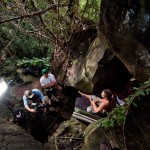
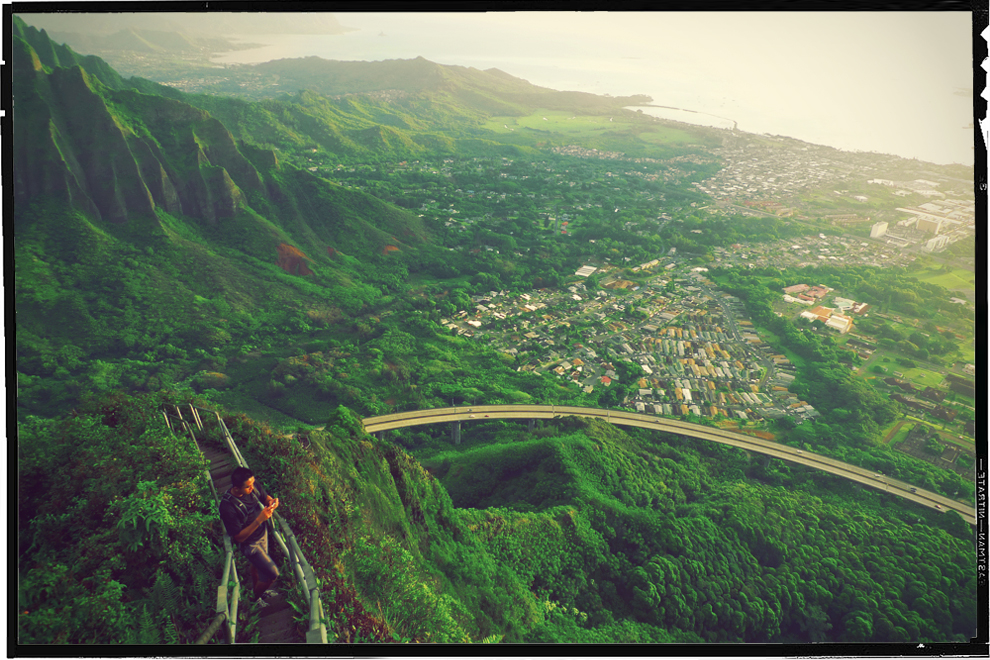
Sam checks his photos. My guess is they are awesome.

I went on hike this morning. I woke up at 4am so I could meet up with friends and be on the trail by 5:30. When we reached the trail head dawn was just barely breaking. It was the coolest hike I’ve ever been on.

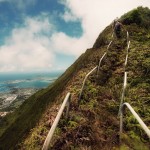
You may have heard of this hike. Most people refer to it as “Stairway to Heaven” but the official name, the one you’ll find on the trail head sign, is Haiku Stairs (or Haʻikū Stairs). It’s a steel staircase made up of 4000 steps that ascends a ridge up from the Valley of Haiku near Kaneohe. The steps were built so the military could access a radio station antennae 2000ft up on the mountain during World War II.

There’s a lot of hype around this hike because one: well, it’s awesome and two: it’s illegal to hike it. It’s not treacherous or anything, but there are some issues with the neighborhood surrounding the trail. We did a lot of research before hiking and the general consensus is that if you get to the trail before the security guard shows up (around 7am) you’ll be fine.

Haiku Stairs isn’t the most difficult hike on the island, but the amazing views and the sheer drop offs on either side of the ridge make it one of the most memorable. While on the steps the word that I kept repeating in my head as a stared at the views was “unreal.”

See more »

Sunrise Panorama

Above
Scroll right to see the sun rising over Kaneohe.

Caught this view a third of the way up the Haiku Stairs.

Makapu’u Tide Pools

Above
Taking a dip with the fishes.

There’s a popular trail on the east side that leads up to the Makapu’u lighthouse. It’s paved, short and easy to walk up. But, not everyone knows that if you veer off the trail you can walk down the side of the cliff to some great tide pools. The east side of the island gets plenty of surf swell so the pools get refreshed constantly. The water is typically clean and full of lively fish.

On hot days when you are looking for a short hike, this is the way to go.

See more »

Waimanalo Beach

Above
Blue sky, blue water.

Waimanalo Beach, I like this place. It’s on the east side of Oahu at the midpoint between Kailua and Hanauma Bay. Even though it’s fairly close to town, there’s no direct route to drive here. You have to drive around the mountains. This little inconvenience keeps this beach less crowded than most other beaches on this side of the island. It seems to have the best of everything. The water is clean, the sand is soft, the scenery is gorgeous and there are fun waves to body surf on.

We spent the weekend here at a beach house for a friend’s birthday. Some serious relaxation occurred.

See more »

Olomana Panorama

Above
Scroll right. The panorama starts with a view to the south (the third peak of Mt. Olomana in view). It follows the Koolau mountain range north, then wraps around to show the beaches on the east (windward) side of Oahu.

I woke up at 6am yesterday. That’s early for me. And it was a Saturday. I don’t even wake up at 6am on weekdays. So why so early? Well, some friends were doing the three peaks hike up Mt. Olomana and I didn’t want to miss out. It’s one of my favorites. And, it’s much more enjoyable if you start before it gets hot. I learned that the first time around.

Mt. Olomana is a small mountain that sits between the Koolau mountain range and Waimanalo Beach. When you’re at the top of the first peak, you have an unobstructed 360 degree view. While many trails in Hawaii give you great views of the ocean, I haven’t been on any that give you such a broad view of the mountains like this. I found a panorama to be appropriate.